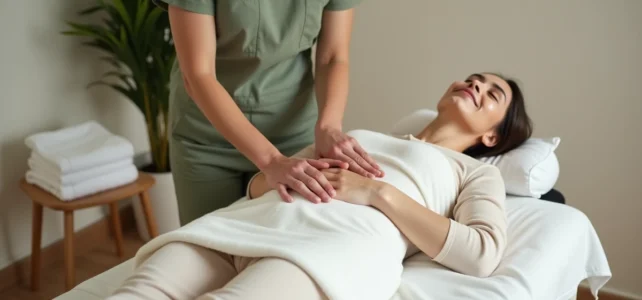
Lymphatic drainage is often presented as a natural solution for achieving a flat stomach. The promise is appealing, but the available clinical data paints a more nuanced picture: the effectiveness of this technique primarily depends on the origin of the abdominal swelling. Post-operative edema, water retention, gas bloating, or visceral fat do not respond in the same way to draining massage.
Lymphatic drainage and bloated stomach: what clinical studies measure
Public content frequently mixes several types of abdominal swelling without distinguishing their mechanisms. Clinical studies, on the other hand, clearly separate the situations.
| Origin of swelling | Mechanism at play | Effect of lymphatic drainage |
|---|---|---|
| Post-surgical edema (abdominoplasty, cesarean section) | Accumulation of interstitial fluid related to inflammation | Significant reduction in edema volume and pain (clinical data 2022-2023) |
| Water retention (hormonal cycle, high sodium diet) | Excess fluid in subcutaneous tissues | Temporary improvement by stimulating lymphatic return |
| Gas bloating / functional digestive disorder | Gas production, visceral hypersensitivity, dysbiosis | No demonstrated effect on gas production or evacuation |
| Abdominal fat | Subcutaneous or visceral lipid storage | No effect on fat mass loss |
A systematic review published in 2023 (Klebanov et al., Journal of Plastic, Reconstructive & Aesthetic Surgery) confirms that drainage reduces edema after abdominal surgery, but shows no direct effect on waist circumference outside of an inflammatory or post-operative context.
A 2022 study (Gonçalves et al., Clinical Rehabilitation) involving patients who underwent cesarean sections reports a visual improvement in swelling as early as the second week of sessions, without any difference in body weight between the drained group and the control group. The stomach appears less bloated, but the scale does not change.
Anyone questioning lymphatic drainage for a bloated stomach should first identify the exact cause of their discomfort before engaging in a series of sessions.

Functional bloating: why lymphatic drainage is not enough
The “stomach that bloats in the evening” is the most common reason for consultation among those seeking drainage. Several studies published between 2021 and 2024 classify this phenomenon as a functional digestive disorder.
The mechanism is different from water retention. It involves a combination of factors:
- An excessive production of intestinal gas related to the fermentation of certain carbohydrates (notably FODMAPs), which external massage cannot evacuate
- Visceral hypersensitivity that amplifies the perception of distension, even when the volume of gas remains normal
- Dysfunction of abdominal-diaphragmatic coordination, where the diaphragm descends and the abdominal muscles relax instead of contracting, creating a visible protrusion without a real increase in abdominal content
In this scenario, the lymphatic system is not involved in the swelling. Stimulating lymphatic circulation does not change either gas production or the viscerosomatic reflex responsible for distension.
Approaches that show results on functional bloating are of a different order: a low-FODMAP diet, hypopressive abdominal rehabilitation, management of intestinal dysbiosis. Drainage may provide a transient feeling of comfort through the relaxing effect of massage, but it does not address the cause.
Abdominal water retention: the only area where drainage really works
Outside of the post-surgical context, manual lymphatic drainage retains measurable interest for individuals whose abdominal swelling is related to water retention in subcutaneous tissues.
This type of retention is recognized by a few signs: the swelling fluctuates with the hormonal cycle, worsens after a high-salt meal, and is often accompanied by a feeling of heaviness in the legs. The skin may temporarily retain the imprint of pressure (a sign of pitting).
The draining massage works here by accelerating the return of lymph to the lymph nodes, promoting the elimination of excess water. However, the effect remains temporary if the triggering factors persist.
- One session provides visible reduction that lasts a few hours to a few days depending on the individual
- The regularity of sessions improves lymphatic circulation in the medium term, but stopping drainage gradually returns the state to baseline
- Combining with regular physical activity and reducing sodium intake prolongs the results of each session

Draining abdominal massage: manual technique or mechanical device
Two approaches coexist. The manual technique, derived from the Vodder method, uses light and rhythmic pressures that follow the path of lymphatic vessels. The pressure applied remains low, on the order of a few tens of grams, to avoid crushing superficial lymphatic capillaries.
Pressotherapy devices apply sequential pneumatic compression. They often cover the lower limbs and pelvis, but the abdominal area remains difficult to treat mechanically without adjusting the pressure to the patient’s morphotype and digestive sensitivity.
In the abdominal area, the manual technique offers an advantage: the practitioner can adjust the pressure and rhythm in real-time according to the tissue’s reaction. This fine modulation is not possible with a standard compression device. For abdominal water retention, the manual method remains the reference in clinical literature.
Lymphatic drainage can indeed reduce a bloated stomach, provided that the swelling comes from excess fluid in the tissues and not from intestinal gas or fat. Identifying the cause before choosing the technique remains the only approach that prevents sessions without results.